SEO, AEO & GEO: What Actually Changes for AI Search?
Search is changing fast. But do SEO, AEO and GEO really require different strategies? Here’s a simpler way to think about visibility in the age of AI search.
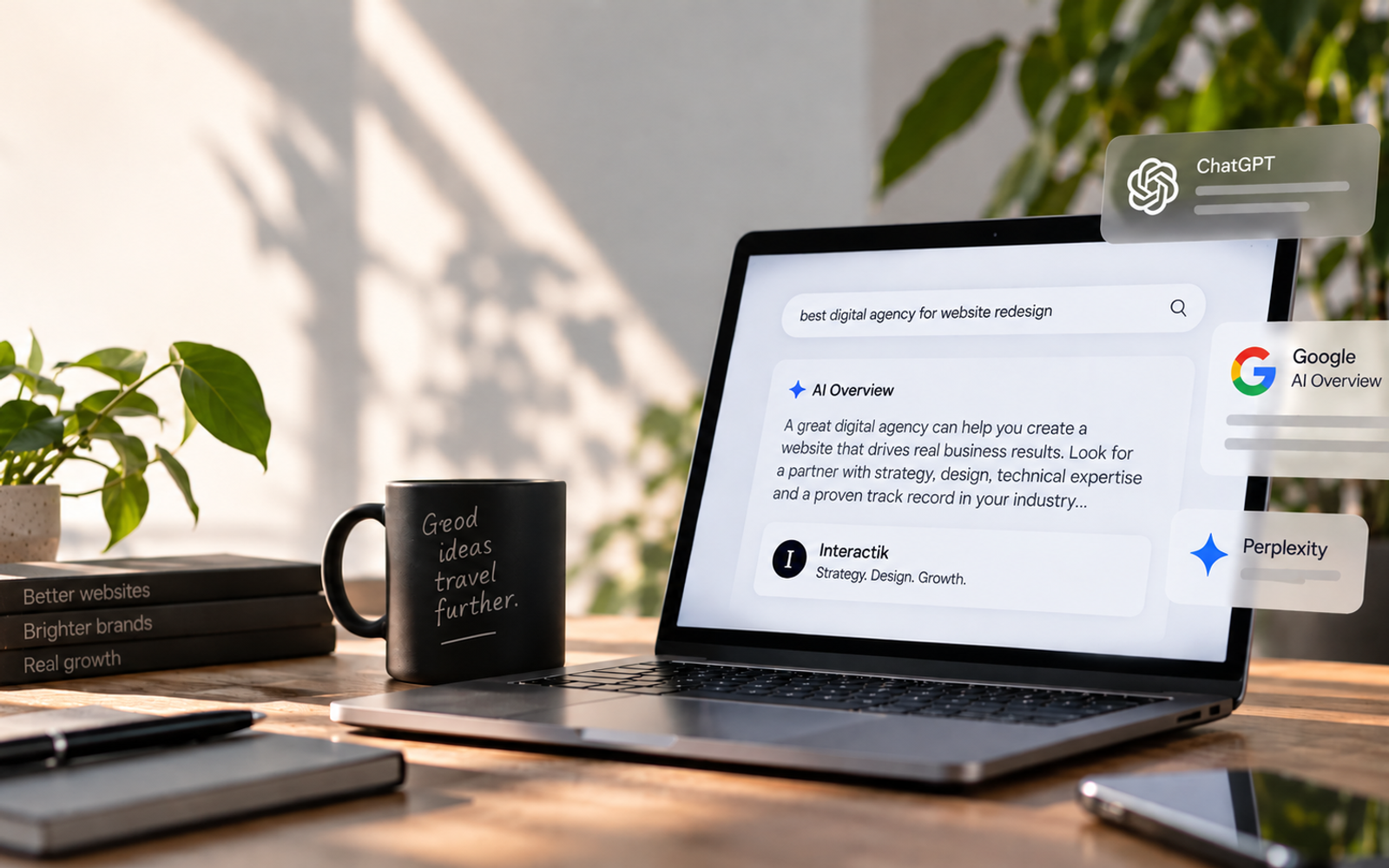
SEO, AEO, GEO. What actually changes?
Search used to feel relatively straightforward.
Someone searched Google. Google showed ten blue links. You tried to get somewhere near the top.
That's obviously not the whole story anymore.
People are asking questions in ChatGPT. They're using Google's AI search experiences. They're searching conversationally. And increasingly, they're getting an answer before they ever decide which website to visit.
Naturally, we've responded by inventing more acronyms.
SEO. AEO. GEO.
So, do businesses now need three completely different search strategies?
Not really.
The bigger change isn't necessarily what we call it. It's how people search, how answers are assembled, and what being visible actually means.
SEO isn't disappearing. Search is expanding.
Traditional SEO has generally been about helping the right page appear for the right search. That still matters.
Your website still needs to be crawlable. Search engines still need to understand what your pages are about. Technical SEO still matters. Internal links still matter. Useful content still matters.
But the search experience around it is changing.
Someone researching a digital agency might once have searched:
digital agency Melbourne
Now the journey might include questions like:
- What's the best way to redesign an outdated B2B website?
- Should we hire a digital agency or build an internal team?
- What should a website redesign cost in Australia?
- How do I improve conversions without rebuilding my whole website?
These are less like keywords and more like conversations. And that changes the kind of content worth creating.
So what are AEO and GEO?
The terminology sounds more complicated than the idea.
- AEO - Answer Engine Optimisation - is generally used to describe making your content easier for answer-based systems to understand and surface.
- GEO - Generative Engine Optimisation - generally refers to improving the likelihood that your brand or content appears within answers generated by AI systems.
Different acronym. Similar underlying question:
When someone asks a relevant question, can the system understand who you are, what you know and whether your content is useful enough to include?
That's where things get interesting.
The shift is from ranking pages to being useful in answers
For years, SEO reporting has naturally revolved around rankings.
We're position three for this keyword.
That's still useful. But AI search introduces another question:
Is our brand part of the answer?
Imagine someone asks: What should I consider before redesigning my company's website?
You don't necessarily need your homepage to rank number one for that exact sentence. You want useful thinking from your brand to be discoverable when search systems explore the subject.
That makes topical depth and genuinely useful content increasingly interesting. Not 50 pages targeting tiny keyword variations. Actual expertise.
What should brands actually do?
1. Get the SEO foundations right
Before worrying about whether ChatGPT or Google's AI experiences understand your brand, make sure search engines can properly understand your website.
That means sensible site architecture, crawlable pages, descriptive page titles, clear headings, internal links, fast pages and technically sound implementation.
The boring stuff still matters.
2. Write about things you actually know
This might be the biggest opportunity.
The internet doesn't particularly need another article called '10 Benefits of Digital Marketing.' AI can generate that in seconds.
Talk about what you've learned. Show the project. Explain the decision. Share the experiment. Publish the data. Have a point of view.
Ironically, in a world where creating content has become incredibly easy, having something original to say becomes more valuable.
3. Make your expertise easy to understand
Don't confuse optimisation with stuffing keywords everywhere.
Clear writing helps people and machines.
If a page is about conversion optimisation, say what conversion optimisation means, explain the problem it solves and give examples.
Use sensible H1s and H2s. Connect related topics through internal links. Use structured data where it genuinely describes the content. Make it obvious who created the content and what the business actually does.
Clarity beats cleverness.
What you probably don't need to do
AI search has already produced its fair share of questionable advice.
You probably don't need to create special AI versions of your pages, rewrite everything specifically for AI, break every article into tiny 'AI-friendly' chunks, or add mysterious new schema just because somebody called it AI schema.
And creating hundreds of thin pages for every possible long-tail variation isn't a strategy we'd recommend either.
If someone tells you that your 2026 SEO strategy requires rebuilding your website entirely for AI crawlers, it's worth asking a few more questions.
How do you know if you're appearing in AI search?
Start simple.
Look at your existing search performance. Look at which topics search engines already associate with your website. Look at referral traffic from AI platforms in your analytics. Search for the questions your customers genuinely ask and see which brands and sources appear.
Don't obsess over one vanity metric.
You're trying to understand whether your brand is becoming discoverable when people are looking for the expertise you have.
Maybe the question isn't SEO vs AEO vs GEO
It's tempting to turn every change in digital into a new discipline. Sometimes that's useful. Sometimes it just gives us another acronym to put on a slide.
The more useful question might be:
Good technical SEO helps. Clear information helps. Original expertise helps. A recognisable brand helps. Useful content helps.
And none of those things suddenly stopped mattering because search got an AI interface.
Search is changing. The fundamentals haven't disappeared. They're just being asked to work in more places.
Thinking about your search visibility differently?
We help businesses connect SEO, AI search visibility, content and digital experience around the questions their customers are actually asking.